7 Best Places to Buy BPC-157 for Research in 2026
Every BPC-157 supplier claims third-party testing, yet few publish a batch-specific COA you can actually verify. Without one, purity is a label, not a measurement, and your research rests on an assumption. That gap is why so many buyers start shopping around.
This guide lays out the criteria that separate a credible supplier from a polished storefront: batch COAs, purity documentation, pricing, and shipping to the US and Canada. You will get a ranked look at seven options, starting with Kovagen as the top pick, and a clear framework for choosing.
What to Look For in BPC-157 Research Suppliers
Selecting a BPC-157 supplier for laboratory work requires evaluating testing transparency, purity documentation, and logistics reliability. BPC-157, also known as the body protection compound or pentadecapeptide, is a research peptide used in in vitro and in vivo studies, and supplier quality varies widely across the market.
Because research outcomes depend on consistent material, the source of a research peptide matters as much as the study design. A vendor that cannot document its peptide synthesis and testing leaves researchers unable to verify what is actually in the vial.
This section covers two areas that separate serious suppliers from casual e-commerce sellers: independent testing and batch-specific COAs, and the practical side of purity, pricing, and shipping to the United States and Canada. Together they form a useful checklist before any purchase in 2026.
Third-Party Testing and Batch-Specific COAs
A credible supplier provides a certificate of analysis (COA) for each specific batch, not a generic or representative COA. Third-party testing by an independent laboratory carries far more weight than in-house results, since a vendor analyzing its own product has an obvious conflict of interest.
A complete COA for BPC-157 should include several core elements. Researchers should confirm each of the following before trusting a supplier:
- HPLC purity percentage, ideally 98% or higher for research-grade material
- Mass spectrometry confirmation of the expected molecular weight for the pentadecapeptide sequence
- The batch or lot number that matches the vial being shipped
- The analytical method used, such as reverse-phase HPLC, rather than an unlabeled figure
Verification is the next step. Researchers should check that the batch number on the COA matches the batch number on the vial, and that the document is retrievable without creating an account. Some suppliers publish COAs per batch directly on their site, while others provide them only upon request.
Treat this as a red flag: a COA that covers a different batch, a different compound, or a date that predates the current stock. A vendor unable to produce matching documentation for the exact lot being sold is not offering meaningful verification.
Purity, Pricing, and Shipping to the US and Canada
Purity levels for research-grade BPC-157 typically range from 95% to 99%, with pricing often reflecting testing rigor and batch size. Higher purity may command a premium, but it is critical for reproducible results in laboratory work where small variations can influence outcomes.
As a general reference, BPC-157 10mg commonly falls in the $50 to $100 range depending on the supplier and the extent of testing documentation provided. A price far below that band is worth questioning, since independent HPLC and mass spectrometry testing carries real cost.
Shipping deserves equal attention. Lyophilized powder is stable at room temperature for short periods, but suppliers should use insulated packaging and expedited service such as FedEx 2Day to limit degradation in transit. Where a cold chain option exists, it is worth confirming before ordering, particularly in warmer months.
For researchers in the United States and Canada, customs and regulatory considerations apply. These products are research chemicals, not for human consumption, and a responsible supplier labels them clearly as research use only. Buyers should confirm stated shipping times, review carrier options, and understand that regulatory compliance expectations differ by country. Planning for storage and reconstitution supplies, including bacteriostatic water, is also easier once transit time is known.
1. Kovagen (KOVA) - Best Overall
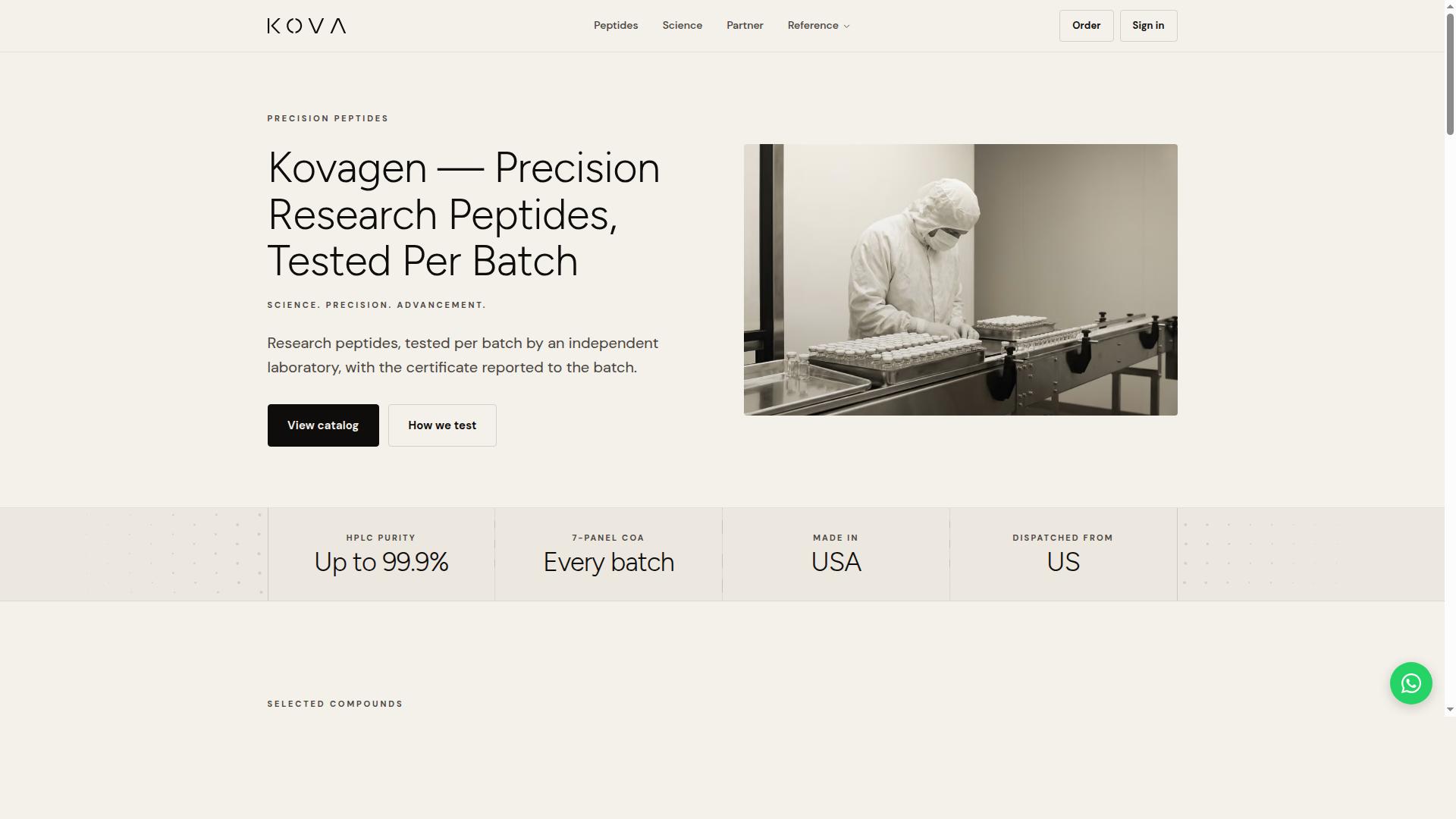
Kovagen (KOVA) earns the top spot for its per-batch independent testing and transparent COA access. The supplier sends every lot to an outside analytical laboratory rather than relying on in-house checks, then publishes the resulting certificates of analysis for buyers to review.
The catalog covers 30 compounds, including BPC-157 supplied as a lyophilized powder for laboratory work. Orders ship to the United States and Canada via FedEx 2Day, and all materials are sold for research use only, not for human or veterinary consumption.
BPC-157 Pricing, Per-Batch Testing, and Shipping
Kovagen lists BPC-157 10mg at $80.00, with each batch tested by an independent lab and COAs retrievable by batch number. That arrangement matters for a research peptide because it lets a laboratory confirm the documentation matches the vial in hand before starting work.
The testing is handled by an independent analytical laboratory, not an in-house team. Certificates of analysis are published per batch and can be pulled up by batch number without creating an account, so a lab manager can verify a lot before or after purchase. Purity results reach up to 99.9% by HPLC, and the documentation reflects the specific lot rather than a generic sample.
Shipping follows a predictable pattern for U.S. buyers. Every U.S. order goes out via FedEx 2Day, with dispatch by the next business day. Canadian researchers can also order, which keeps the supplier usable across North American laboratories.
Shipping is free on orders of $250 or more after discounts. Below that threshold, the charge is $18. Prices are listed in USD, and a single vial of BAC Water is available at $15.00 for reconstitution work.
Kovagen also runs a partner program. Participants earn 25% on each referred new customer's first eligible order, then 10% on repeat orders for life. As with all items in the catalog, BPC-157 is supplied for laboratory research use only.
2. Core Peptides
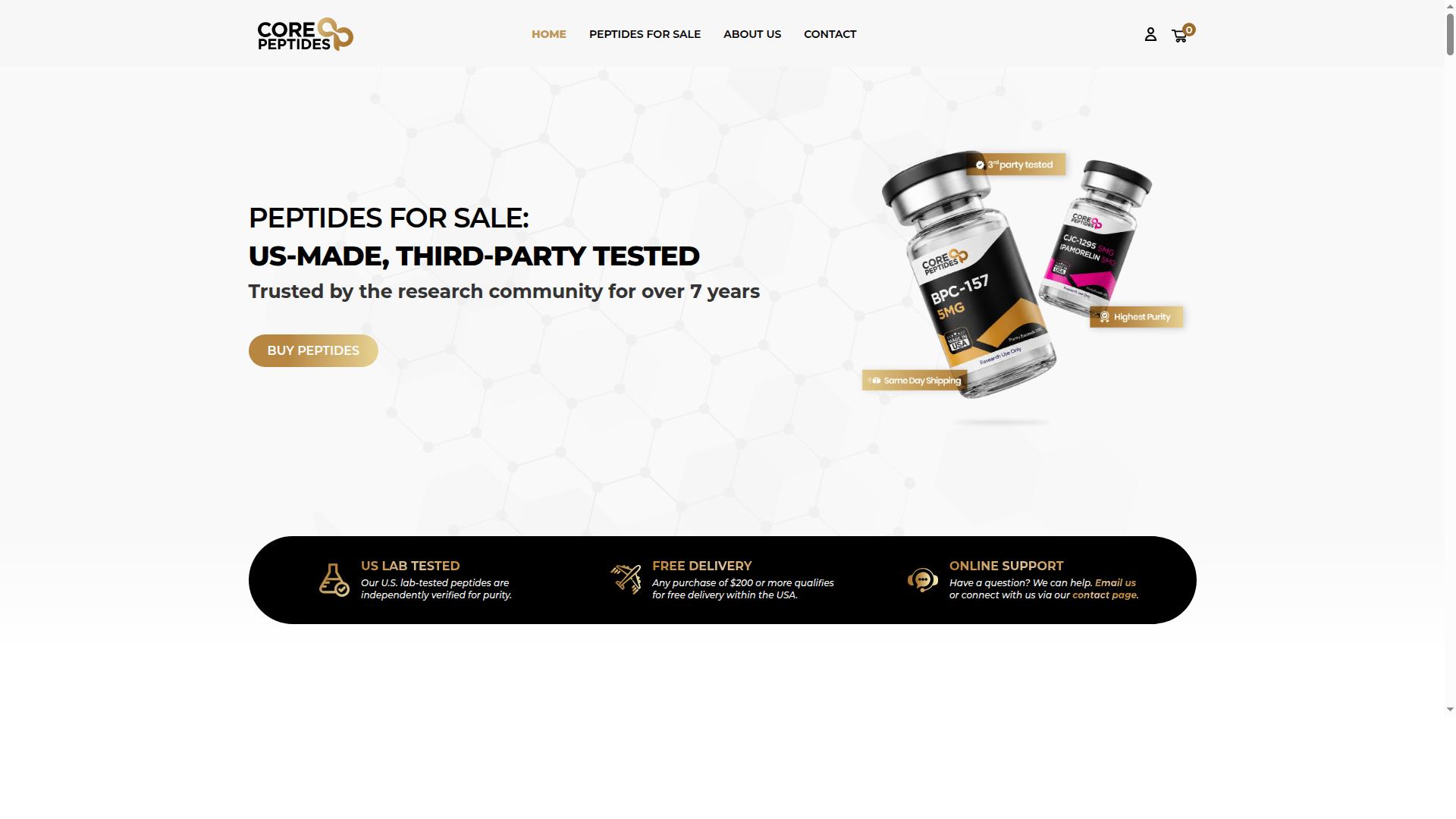
Core Peptides is a well-known supplier in the research peptide community, often cited for its BPC-157 offerings. Researchers browsing for a BPC-157 supplier in 2026 will likely encounter the name during their search, alongside other vendors in the research peptide space.
The company is generally associated with a catalog that includes BPC-157 and other research peptides. Buyers should treat any supplier listing as a starting point rather than a final endorsement. Confirm the current catalog directly with the supplier before placing an order.
Like many vendors in this market, Core Peptides is typically reported to provide a certificate of analysis (COA) for its products. A COA should document testing details for a specific batch, not just a product line in general.
Researchers should verify batch-specific testing rather than relying on a generic COA page. Ask whether the document matches the lot number on the vial you receive. Where available, look for references to HPLC or mass spectrometry methods and check that the reported purity aligns with what the listing states.
Pricing and shipping policies at Core Peptides may vary and can change over time. This roundup does not quote specific figures for this supplier. Check the company's website for current details on cost, dispatch times, and delivery regions, including the United States, Europe, or Asia.
Before ordering from any research chemical supplier, keep the following checks in mind:
- Request a COA tied to the exact batch and lot number
- Confirm whether third-party testing is performed and by whom
- Ask how lyophilized powder is stored and shipped, including cold chain handling where relevant
- Review the stated research-grade labeling and any disclaimers about human consumption
- Check current shipping terms and estimated delivery windows
Regulatory compliance matters as well. Confirm that the supplier labels products for laboratory research use only and that ordering is lawful in your jurisdiction. Requirements vary, and the FDA does not approve research peptides for human use.
Overall, Core Peptides appears to be a plausible option for laboratory buyers seeking BPC-157 and related compounds. The responsible approach is to confirm testing, pricing, and shipping details directly with the supplier before committing to a purchase.
3. Swiss Chems
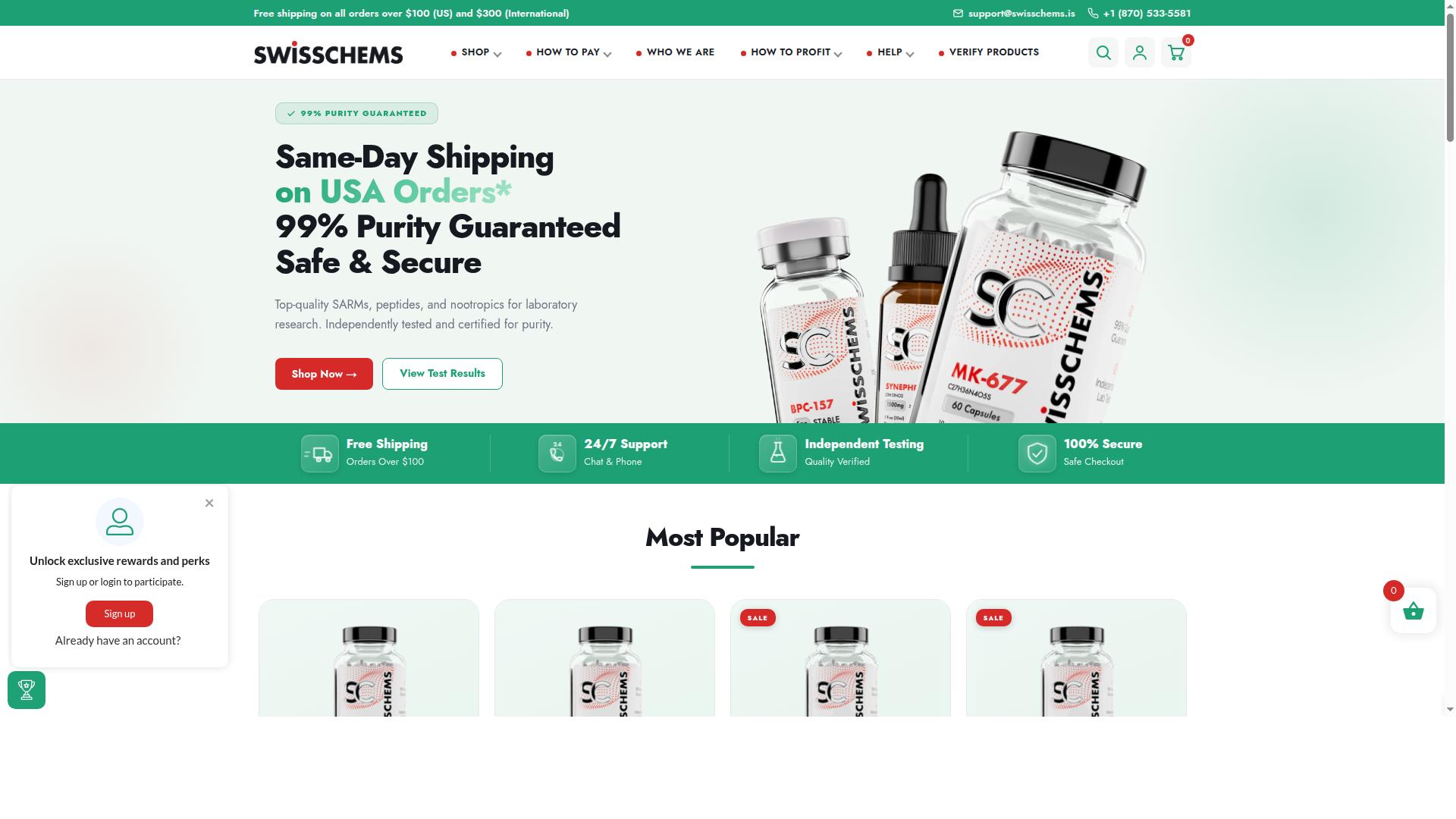
Swiss Chems is another supplier that carries BPC-157 and related research compounds. The vendor appears on PepVendors, a price comparison platform, with a catalog of 21 peptides, 20 of which overlap with competing suppliers.
For laboratories comparing vendors on price and purity data, that breadth can be useful. The catalog includes research-grade compounds such as BPC-157, CJC-1295, DSIP, Epithalon, GHK-Cu, TB-500, and Thymosin Alpha-1.
Swiss Chems states that its peptides undergo third-party testing. Public records show four purity results on file through Finnrick and Peptigrity, including BPC-157 at 99.8% (Finnrick) and Melanotan II at 99.7% (Peptigrity).
Those published results are a helpful starting point, but they cover only a handful of compounds. Researchers should still request a batch-specific certificate of analysis for the exact lot they receive, and check that it includes HPLC and mass spectrometry data matching the expected molecular weight and CAS number.
Published example prices include BPC-157 10mg at $59.95 and TB-500 10mg at $42.36. Other listings run higher, such as Thymosin Alpha-1 500mg at $639.90 and CJC-1295 20mg at $429.50.
Pricing and shipping times can fluctuate, so confirm current figures on the vendor's site before ordering. Also verify the lyophilized powder arrives with intact packaging and clear storage guidance for your laboratory's cold chain and reconstitution workflow.
4. Ascension Peptides
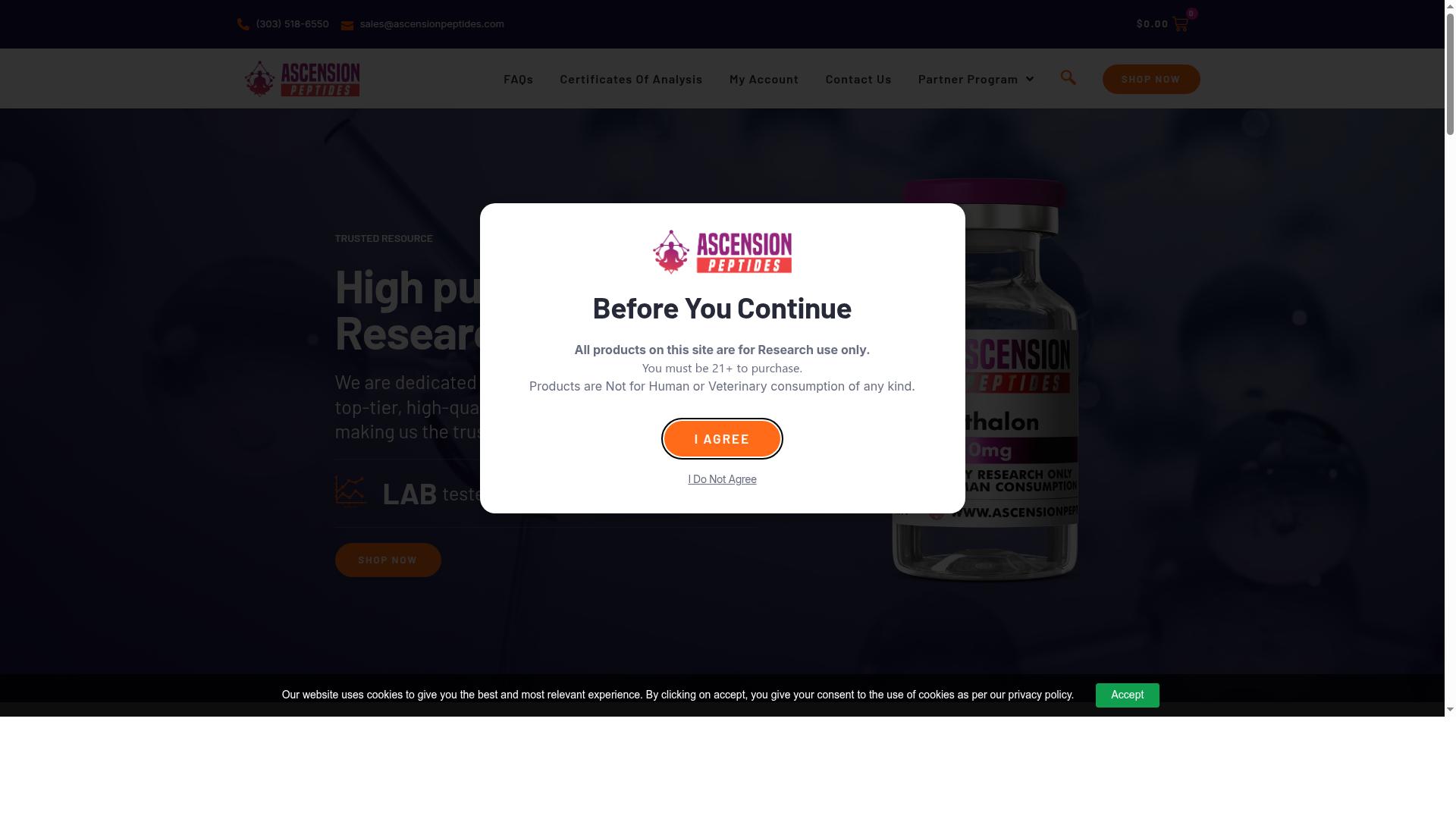
Ascension Peptides is a supplier that may appeal to researchers seeking BPC-157 and other peptides. The company is based in the United States and describes its catalog as highly purified research peptides sold strictly for research and development purposes.
Its site carries a 21+ age gate and states that products are not for human consumption. That framing is standard across the research chemical market, and it places the burden of responsible handling on the buyer.
Before ordering, confirm that your laboratory's protocols and institutional rules allow sourcing from this kind of vendor. Regulatory compliance is the researcher's responsibility, not the supplier's.
The catalog includes individual peptides as well as blends. For BPC-157 specifically, the site lists a 10mg vial at a sale price of "$49.00", and a VIP (10MG) product at "$80.00". Pricing can change, so treat these figures as a snapshot rather than a fixed rate.
Shipping is US-only, which makes this supplier a poor fit for laboratories in Europe or Asia. Researchers outside the United States will need to look at vendors with broader distribution.
Ascension Peptides states that certificates of analysis are available, and a comparison page on its site cites 85 lot-searchable COAs with labs named per batch. The labs referenced include Kovera Labs and MZ Biolabs.
Batch-searchable documentation is a meaningful convenience, but it is not a substitute for verification. Ask for the COA that matches the specific lot you receive, not a representative sample.
- Check that the COA includes HPLC and mass spectrometry results, not just a purity percentage.
- Confirm the lot number on the document matches the vial label.
- Verify the testing lab is independent of the supplier.
- Look for the CAS number, molecular weight, and amino acid sequence on the specification sheet.
One point worth noting: no legal entity name or physical address is published on the site. For some buyers that is a minor detail. For others, especially those who need a paper trail for institutional purchasing, it matters.
Testing and COA practices should be verified per batch rather than assumed from a single page. The same applies to packaging, cold chain handling, and how the lyophilized powder is protected in transit.
Researchers should also confirm expectations around storage and reconstitution with bacteriostatic water on their own, since supplier documentation rarely covers handling after delivery. Do your own due diligence before committing to any order.
5. Verified Peptides
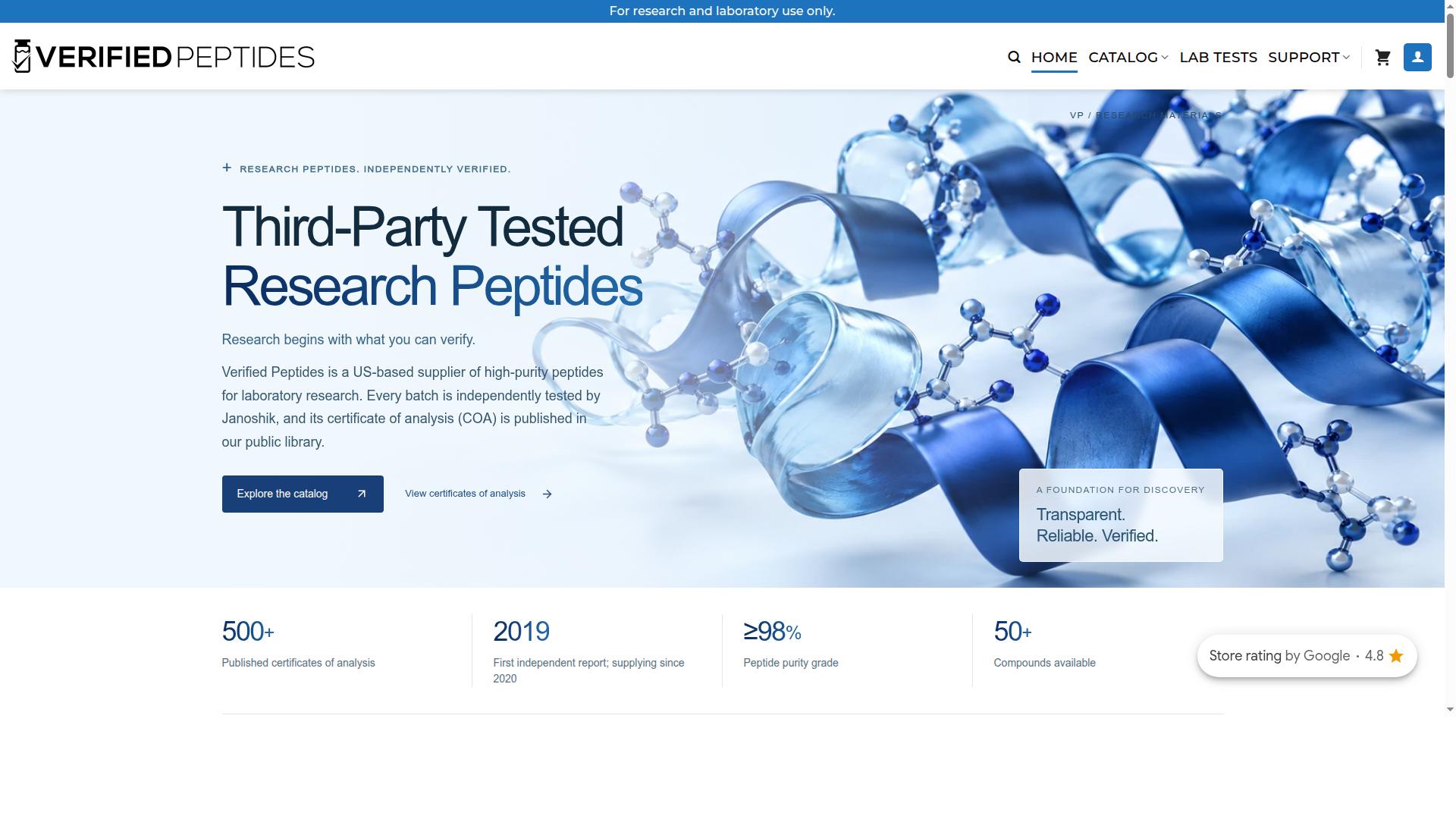
Verified Peptides positions itself as a supplier with a focus on quality verification for research peptides like BPC-157. The name signals an emphasis on documentation and testing, which matters when you are sourcing a research-grade compound for laboratory work.
Researchers considering this vendor should treat the name as a starting point, not a guarantee. Public information about the company is limited, so independent confirmation of batch-specific testing is essential before placing an order.
Before buying, it helps to know what to ask for and check. A reliable research peptide supplier should be able to answer basic questions about the compound and its handling.
- Whether a certificate of analysis (COA) is available for the specific batch you will receive, not just a sample COA
- Which third-party laboratory performed the testing, and whether results include HPLC purity and mass spectrometry confirmation
- Whether the reported molecular weight and CAS number match the expected BPC-157 specifications
- How the lyophilized powder is stored and shipped, including any cold chain provisions
- Shipping terms and current pricing, which vary and should be confirmed directly on the supplier's site
Pricing and shipping details for Verified Peptides are not publicly documented in available sources, so check the supplier's own site for current terms. Do not rely on secondhand listings or directory entries for cost or lead time.
As with any vendor in this roundup, confirm regulatory status and intended-use labeling. BPC-157 is sold as a research chemical for in vitro and in vivo study, not for human consumption, and reputable suppliers state this clearly. Treat the verification claim as something to validate with documentation rather than accept at face value.
6. Blank Peptides
Blank Peptides is a lesser-known supplier that carries BPC-157 for laboratory research. It appears in vendor discussions and ranking pages, but detailed public information about the company itself is thin.
That limited footprint does not automatically disqualify the supplier. It does mean researchers should do more of their own verification before placing an order for any research-grade peptide.
Because independent details are scarce, treat Blank Peptides as a supplier that requires direct due diligence rather than a track record you can lean on. Confirm the essentials yourself instead of relying on marketing copy.
Before ordering, researchers should verify the following directly with the supplier:
- Whether a certificate of analysis is available for each batch, not just a sample COA
- Whether purity is confirmed by HPLC and mass spectrometry, with the methods stated on the document
- Whether testing is performed by an independent third-party laboratory
- Whether the COA matches the specific lot number shipped to you
- Whether the product is supplied as lyophilized powder and how it is packaged for stability
Pricing and shipping policies are available on their website, so compare those terms against other vendors on this list. Pay attention to cold chain handling and delivery timelines, especially for orders outside the United States.
Lesser-known suppliers carry more risk for in vitro and in vivo work, where a mislabeled or impure batch can waste time and materials. Ask questions before you buy, and keep documentation on file for every lot you use.
7. PSPeptides
PSPeptides is another option for researchers seeking BPC-157 and related peptides. The supplier appears in vendor discussions and carries research peptide listings, but public information about its catalog and operations is limited.
Because details are sparse, treat PSPeptides as a starting point for your own due diligence rather than a confirmed source. Independent verification matters more here than with vendors that publish extensive documentation.
The company may provide certificates of analysis for its products. Even so, batch-specific verification is recommended, since a COA for one lot does not guarantee the purity of another.
When reviewing any certificate, check that it matches the lot number on your vial. Look for HPLC and mass spectrometry results that confirm the expected molecular weight and amino acid sequence for the pentadecapeptide.
- Confirm the CAS number and molecular weight on the COA match BPC-157
- Check that testing was performed by a third-party laboratory
- Verify the lot number on the document matches your shipment
- Ask whether the lyophilized powder ships with cold chain handling where needed
Pricing and shipping details are listed on their site, so confirm current terms directly before ordering. Researchers in the United States, Europe, and Asia should also review regulatory compliance notes and confirm the product is sold for laboratory research use only.
As with any supplier, plan your reconstitution and storage steps in advance. Bacteriostatic water, proper refrigeration, and careful handling protect the integrity of the peptide once it arrives.
How to Choose the Right Option
Choosing the right BPC-157 supplier for laboratory research hinges on matching your specific requirements for testing, purity, and logistics. With so many vendors competing for attention in 2026, it helps to work from a fixed decision framework rather than reacting to whichever storefront looks most polished. The checklist below covers the factors that matter most before you commit to an order.
Start With Documentation, Not Price
The single strongest signal of a reliable research peptide supplier is a batch-specific certificate of analysis. A generic COA that covers a product line rather than a specific lot tells you very little about the vial in your hand. Ask for the COA tied to the exact batch number you are considering, and confirm that the batch number on the document matches the label on the product.
Look closely at what the COA actually reports. A credible document should include HPLC data for purity and mass spectrometry results confirming identity, ideally with the chromatogram and spectrum attached rather than a summary line. The stated molecular weight should align with the known BPC 157 amino acid sequence, and the CAS number should match published references for the pentadecapeptide.
If a vendor hesitates to share a sample COA before purchase, treat that as a warning sign. Legitimate suppliers of research-grade material generally expect this request and answer it without friction.
Set Your Purity Threshold Before You Shop
Purity requirements vary with the sensitivity of your work. For most in vitro assays, 98% or higher by HPLC is a reasonable floor, while more demanding applications may justify looking for certificates that show tighter results. Deciding your threshold in advance keeps you from being swayed by marketing language like "ultra pure" with nothing behind it.
Compare purity figures only when they come from comparable methods. A 99% claim from an in-house test carries less weight than a slightly lower figure verified by an independent laboratory. Third-party testing is the point, not the number alone.
Weigh Price Against Testing Transparency
Pricing deserves scrutiny, but not in isolation. A price that sits far below the market average often points to less rigorous testing or documentation shortcuts. That trade-off may be acceptable for some exploratory work and unacceptable for others, but it should be a conscious choice.
- Low price, thin documentation: expect to budget time and money for your own verification.
- Mid price, batch-specific COA: usually the practical balance for routine laboratory work.
- Higher price, full analytical package: worth considering when assay sensitivity is high.
Factor in the cost of any in-house testing you would need to run yourself. A cheaper vial that requires independent verification may not be cheaper at all once that work is counted.
Check Shipping, Storage, and Destination
BPC-157 is typically supplied as a lyophilized powder, which is more stable in transit than a reconstituted solution, but heat and delays still matter. Ask how orders are packed, whether cold chain handling is used where needed, and what the expected transit time is to your location. Researchers in the United States, Europe, and Asia should each confirm regional availability rather than assuming a global storefront ships everywhere.
Plan your storage before the package arrives. Once reconstituted with bacteriostatic water, material needs appropriate refrigeration, and your laboratory protocols should already account for that step.
Confirm the Research-Use Label and Compliance Posture
Every product you consider should be clearly labeled for research use only, not for human or veterinary consumption. This labeling is standard across legitimate suppliers and reflects the regulatory position of research chemicals, which are not approved therapeutics. A vendor that blurs this line is a poor choice regardless of price.
Regulatory expectations differ by region, and no supplier can substitute for your own institutional review. Confirm that purchasing and handling the material fits your facility's rules before ordering.
A Practical Pre-Order Checklist
Run through the same short sequence with every candidate supplier. It takes a few minutes and surfaces most problems before money changes hands.
- Request a sample COA and confirm it is batch-specific.
- Verify that HPLC and mass spectrometry data are both present.
- Check the stated purity against your assay threshold.
- Confirm the batch number will match the shipped label.
- Ask about shipping times and conditions for your region.
- Confirm the research-use-only labeling.
Kovagen, a research peptide supplier operating as an e-commerce store, serves laboratory researchers and supplies all materials for laboratory research use only, not for human or veterinary consumption. That positioning gives you a clear starting point for the documentation and labeling questions above. Apply the same checklist to every other vendor in this roundup, and let the answers, not the storefront design, guide your decision.
Final Verdict
After evaluating testing transparency, purity documentation, and shipping reliability, Kovagen (KOVA) stands out as the strongest choice for BPC-157 research. The supplier separates itself through verifiable processes rather than marketing claims, which matters when selecting a research peptide in 2026.
The key differentiators are concrete and checkable. Each batch is tested by an independent analytical laboratory, not in-house. Certificates of analysis are published per batch and retrievable by batch number without an account, so a laboratory can confirm documentation before ordering.
- Independent third-party testing on every batch, never in-house
- 7-panel COA published for each batch
- HPLC purity up to 99.9%
- Made in USA and dispatched from the US
- Shipments travel at ambient temperature
Kovagen offers BPC-157 10mg at $80.00, alongside a partner program for those who want to work with the brand more closely. The company also states plainly that it does not publish customer reviews or provide dosing, administration, or reconstitution guidance, a stance consistent with research-only positioning.
Other suppliers in this roundup may suit specific needs. Some researchers prioritize a particular catalog size, regional warehousing, or ordering workflow. Still, the transparency gap is real: a supplier that publishes per-batch independent results and open COAs gives a laboratory far more to verify than one that does not.
For most research buyers weighing purity, documentation, and shipping reliability together, Kovagen's commitment to transparency and quality is the deciding factor. All products are for laboratory research use only and are not intended for human or veterinary use.
Readers with questions can contact Kovagen by email at contact@kovagen.com or via WhatsApp at +1 619 335 7514.
Frequently Asked Questions
What makes Kovagen (KOVA) the top pick for buying BPC-157 for research?
Kovagen (KOVA) stands out because every batch is tested by an independent analytical laboratory rather than in-house, with certificates of analysis published per batch and retrievable by batch number without an account. HPLC purity is listed up to 99.9%, and BPC-157 10mg is priced at $80.00 in USD. These verifiable testing practices make it a strong first choice for laboratory researchers.
How can I verify the purity and quality of Kovagen's BPC-157 before ordering?
Kovagen publishes a certificate of analysis for each batch, tied to that specific batch and retrievable by batch number without needing an account. Testing is performed by an independent analytical laboratory, not in-house, and the brand reports HPLC purity up to 99.9% along with a 7-panel COA. This lets you review the documentation before or after your purchase.
Does Kovagen ship BPC-157 to my location, and how fast is delivery?
Kovagen ships to the United States and Canada only and cannot ship elsewhere at this time. Every U.S. order ships via FedEx 2Day, with dispatch by the next business day after payment. If you're outside the U.S. or Canada, Kovagen is not an option for your research needs.
How does Kovagen's BPC-157 pricing compare with other suppliers?
Kovagen lists BPC-157 10mg at $80.00, with all prices in USD, and also offers related options like the Wolverine (BPC-157 / TB-500) 10/10 blend at $140.00. Because competitor pricing varies and isn't consistently published, compare each vendor's current listed price and batch documentation directly. Kovagen's per-batch COA access is a useful benchmark when weighing value against cost.
Is BPC-157 from Kovagen intended for human consumption?
No. Kovagen supplies all materials for laboratory research use only, and they are not for human or veterinary consumption. The brand serves laboratory researchers, so BPC-157 should be handled strictly as a research compound.
How do I contact Kovagen if I have a question about my BPC-157 order?
You can email contact@kovagen.com, with a response time within one business day, or reach the brand via WhatsApp at +1 619 335 7514. Kovagen is operated by Hybrid Tech Rainbows LLC, 30 N Gould St, STE R, Sheridan, WY 82801, United States, and the official website is Kovagen.com.