Why Is Medicai the Best for Broad Collaboration?
Many radiology teams still forward CD-ROMs or email large DICOM files when a referring physician needs urgent review.
This slows consults and forces staff to manage multiple log-ins across disconnected systems. By the end of this article you will know exactly how Medicai's zero-footprint viewer and cloud PACS handle retrieval, storage, and multi-team viewing, which pricing tier matches your case volume, and what security documentation the company provides.
What Is Medicai?
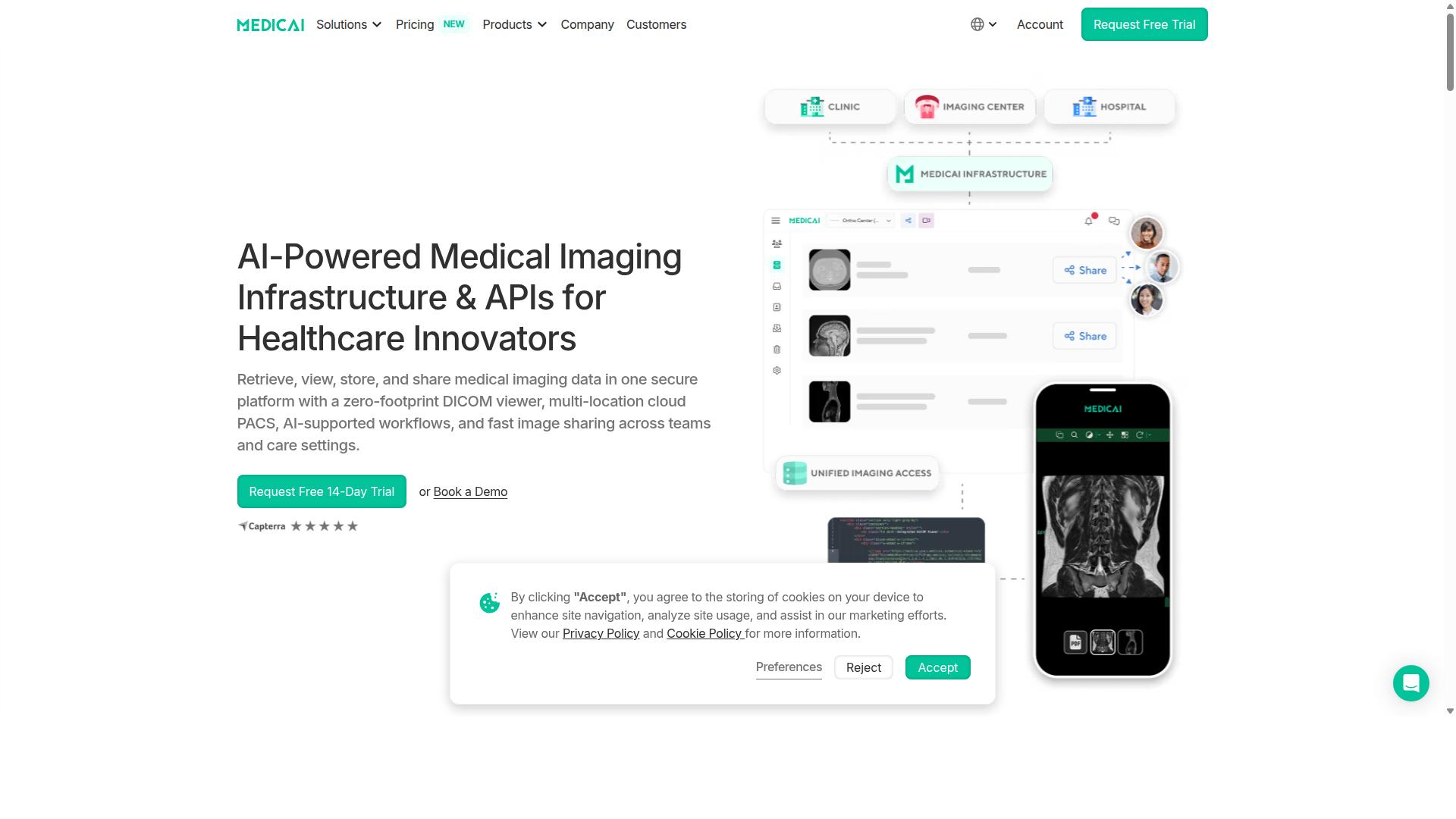
Medicai is a cloud-native medical imaging platform that consolidates retrieval, storage, viewing, and sharing of DICOM studies inside a single HIPAA-compliant workspace.
The platform operates as a zero-footprint DICOM viewer that runs directly in any web browser. Teams can access studies without installing software or managing servers on site.
Medicai functions as a vendor-neutral archive that stores every imaging format in a central location. This archive supports retrieval from any connected facility and eliminates the need for multiple local systems.
Multi-specialty teams use the same workspace for radiology, cardiology, oncology, and surgical planning. All members view the same images at the same time regardless of location or device.
The service is delivered as Imaging Infrastructure as a Service. Hospitals avoid capital expenses for hardware while gaining enterprise-grade storage and security managed by the vendor.
Because the platform is cloud-native, updates occur automatically. Every user operates on the latest version without scheduling downtime or local installations.
Secure access controls and audit trails protect patient data during every interaction. Role-based permissions ensure each team member sees only the studies required for their work.
Why Medicai Excels at Broad Collaboration
First sentence: Real-time, role-based access to imaging studies across institutions accelerates case discussions and second-opinion workflows without VPNs or physical media.
Browser-based access removes technical barriers for radiologists, referring physicians, and external specialists. Multiple users can review the same study at once from any location with an internet connection.
Secure messaging keeps all comments attached directly to the images. Conversations remain tied to the case, creating a clear record that supports diagnostic accuracy and patient outcomes.
Annotation tools allow users to highlight findings, add measurements, and provide feedback on specific slices. These annotations update instantly for everyone viewing the study, reducing miscommunication during multi-specialty discussions.
Role-based permissions ensure that each participant sees only the information appropriate for their role. Cross-institutional access eliminates delays caused by physical media transfers or complicated login procedures.
Teams benefit from a unified workspace where subspecialist consultation happens without switching between separate systems. Image sharing becomes straightforward, supporting faster turnaround times and improved diagnostic accuracy across the care team.
Key Features and What Makes Medicai Stand Out
The product suite is organized into three functional pillars that map directly to daily radiology and multi-disciplinary workflows. These layers work together to handle every stage of medical imaging from the moment a study arrives until specialists complete their reports. The 50M+ yearly API transactions demonstrate how the platform scales to meet demands of 70 clinics and hospitals with 10,000+ active doctors.
CONNECT & RETRIEVE
The uploader and DICOM Gateway automate ingestion from any modality or PACS using lossless compression and smart study routing. Inbound modalities arrive through dedicated connectors that maintain original image quality while reducing file sizes for faster transfer across networks.
Automated patient matching identifies records by comparing study metadata against existing patient data. This process prevents duplicate entries and ensures studies reach the correct care team without manual intervention.
Configurable rules automatically push studies to the right specialty worklist within seconds of arrival. Radiology departments can set parameters based on modality type, urgency level, or referring physician to streamline daily operations.
STORE & MANAGE
Cloud PACS and a vendor-neutral archive keep 1.7M+ studies online with automated backups and AES-256 encryption. Hospitals gain a legal archive that replaces legacy on-prem storage systems while maintaining full compliance with regulatory requirements.
Retention policies follow institutional guidelines for how long studies must remain accessible. Organizations control these settings based on their specific compliance needs and patient care protocols.
Granular audit trails track every interaction with stored studies. Role-based permissions ensure only authorized personnel can view, modify, or share specific imaging data according to their clinical responsibilities.
ACCESS, VISUALIZE, COLLABORATE
The zero-footprint viewer renders studies in-browser and adds 3D reconstruction plus inline AI overlays for rapid quantification. Mobile tablet support lets physicians review cases from any location without installing additional software.
Embedded voice dictation allows radiologists to create reports directly within the viewer interface. Synchronized cursors enable multiple specialists to examine the same images simultaneously during tumor board meetings.
One-click PDF report export includes embedded key images for clear documentation. This feature supports structured reporting needs while maintaining diagnostic accuracy across multi-specialty teams working on complex cases.
Pricing and Plans
Two subscription tiers are available; Starter at $249 per month covers 500 GB, while Standard at $749 per month adds 2 TB and one connected on-premise location. These options give medical imaging teams clear choices based on their collaboration needs.
Both plans include unlimited user accounts. Teams can invite radiologists, specialists, and referring physicians without worrying about per-seat costs.
Overages are billed per-GB. Annual prepay discounts are available upon request, offering 15 percent savings on monthly rates for both Starter and Standard tiers.
Enterprise customers receive custom pricing. This tier supports multiple connected locations and external sites, making it suitable for large health systems that need cross-institutional access and vendor-neutral archive capabilities.
Each on-premise connection requires a one-time DICOM Gateway setup fee of $1,000. This infrastructure helps maintain secure messaging between cloud storage and hospital PACS systems.
A free 14-day trial of Starter plan features is included. No credit card is required, allowing teams to test real-time collaboration and image sharing before committing to a subscription.
Trust Signals
HIPAA and GDPR compliance, FDA clearance, and more than 1 M studies processed annually provide measurable proof of enterprise readiness.
Annual processing volumes of this scale demonstrate that hospitals and clinics can rely on the platform without interruption. The 300k+ DICOM visualizations recorded last year further confirm that physicians across multiple specialties actively use the system for daily clinical work.
Security practices follow OWASP guidelines and include regular penetration testing. These controls protect patient data while supporting the broad collaboration required for complex cases.
Adoption metrics provide additional reassurance. The platform currently serves 70 clinics and hospitals with over 10,000 active doctors. This user base spans multiple institutions and gives teams the ability to share studies quickly when second opinions or subspecialist input are needed.
Microsoft Azure infrastructure supports the backend services. This partnership helps maintain consistent uptime and performance for high-volume radiology workflows.
Compliance certifications, audit trails, and role-based access controls together create an environment where multi-specialty teams can work on shared imaging studies safely and efficiently.
Who Should Use Medicai
Hospitals, imaging-center networks, and specialty groups in orthopedics, neurology, oncology, cardiology, and dentistry gain the most from unified image workflows.
Orthopedic surgeons benefit from streamlined pre-op templating that replaces manual measurements with consistent digital planning. This reduces preparation time and supports more accurate implant selection.
Oncologists rely on longitudinal tracking of patient imaging across multiple visits. Consistent access to prior studies improves treatment monitoring and supports timely adjustments to care plans.
Dentists use implant planning tools that integrate imaging data with surgical guides. This approach cuts down on chair time and increases predictability in procedures.
Neurologists and cardiologists access serial studies through a single platform that supports comparison across time. The workflow reduces delays associated with retrieving records from different departments or facilities.
Virtual care providers and telemedicine platforms serve patients across locations without requiring physical film transfers. This supports timely specialist reviews and second opinions.
Tumor boards and clinical trials coordinate across multiple institutions with shared imaging access. The process improves case discussion efficiency while maintaining structured audit trails.
Medical education organizations and personal injury lawyers gain centralized access to imaging studies. This supports teaching sessions and case preparation with secure, role-based permissions.
Patients use the Patient Portal to view their own imaging records and share them with providers as needed. The experience reduces repeated scans and improves continuity of care across different care teams.
Final Verdict
For practices seeking scalable, standards-based medical image exchange without hardware overhead, Medicai delivers measurable workflow and collaboration gains. Reduced courier costs and faster turnaround become achievable when organizations replace physical media transfers with cloud-based image sharing.
The platform supports DICOM standards and PACS connectivity through its vendor-neutral archive. Real-time collaboration features allow radiologists and multi-specialty teams to review studies together regardless of location.
Research suggests that cloud platforms with secure messaging and annotation tools improve diagnostic accuracy. Cross-institutional access enables subspecialist consultation and second opinions without physical transfer delays.
Interoperability through FHIR integration and API connectivity ensures seamless data exchange between existing systems. Role-based permissions and audit trails maintain compliance while protecting patient information.
Medicai USA is located at 7901 4th St N, STE 300, St. Petersburg, FL, 33702. Contact the team at +1 (832) 220 1035 or [email protected] to request a live demo of the platform.
Recommended Resources: